Costa Ricans appear to endorse continuity of Chaves program in tight vote
Preliminary counts show Laura Fernández on track to win with 48.94 percent, a test of outgoing president Rodrigo Chaves’s security-first agenda.

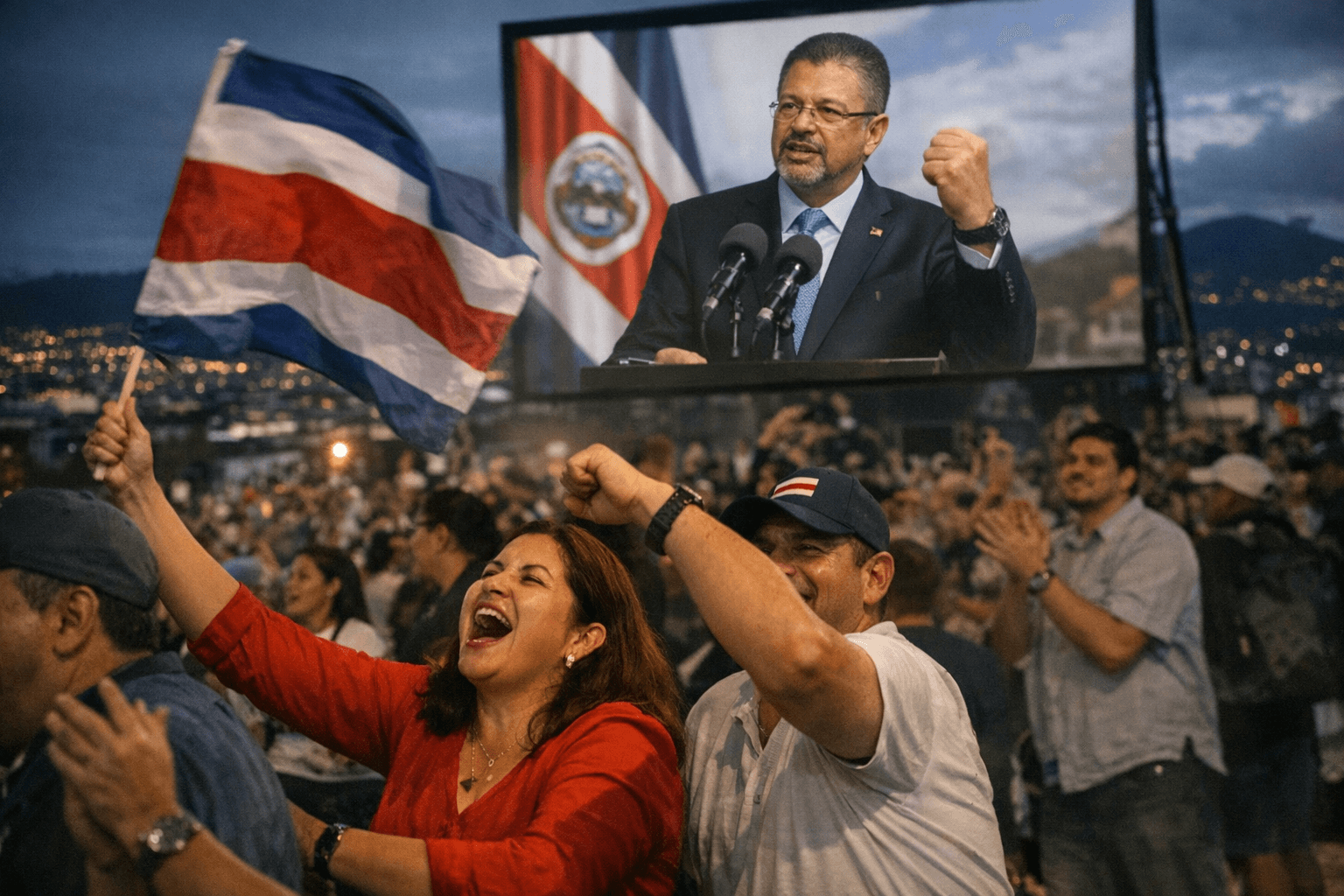
With more than 80 percent of polling stations tallied, Laura Fernández had secured 48.94 percent of the vote in preliminary returns, a total that would clear the 40 percent threshold required to avoid a runoff and place the candidate handpicked by outgoing president Rodrigo Chaves on course for the presidency. More than 3.7 million Costa Ricans were eligible to vote in the election that also filled the 57-seat Legislative Assembly.
Fernández ran explicitly as the continuity candidate for Chaves’s center-right, populist movement, campaigning on a pledge to press forward with hardline public security policies. After preliminary results were announced she told supporters, "Costa Rica has voted for the continuity of change, a change that seeks to restore and improve institutions and return them to the sovereign people in order to create greater well-being and prosperity." Her closest rival, centrist economist Álvaro Ramos, conceded late on Sunday and said his party would "support her when her decisions are for the good of the country."
Security emerged as the dominant concern for voters, eclipsing the economy in this cycle. Analysts and polling during the campaign highlighted rising public anxiety over crime: Chaves’s term was marked by what electoral observers described as a sharp rise in violence, a trend the outgoing president attributed to a judiciary he said was too soft on criminal networks. A Jan. 21 poll by the University of Costa Rica’s Centre for Political Research and Studies found nearly 79 percent of respondents reported little or no enthusiasm for the campaigns, even as more than 57 percent said they felt motivated to vote and 19.5 percent said they had no desire to participate. The poll also showed a large bloc of undecided voters, cited variously as about 26 percent and as many as a third in reporting, underscoring volatility that helped propel Chaves to victory in 2022 after low polling earlier that year.
The result, if confirmed by the electoral tribunal, would be read as a mandate for policy continuity on public safety and a test of how far a Chaves-aligned administration can push reform while managing institutional checks. Rodrigo Chaves, speaking after returns, sought to reassure critics, saying there would be "neither dictatorship, nor communism" under the movement’s governance. Among voters, some celebrated a tough-on-crime approach. "The violence exploded because they (the government) are going after the ringleaders, it's like dragging rats out of the sewer," said Jessica Salgado, 27, who voted for Fernández.
Beyond security, the election highlights a broader political realignment. Ronald Alfaro, coordinator of the Public Opinion and Political Culture Unit at the University of Costa Rica, said the contest reflected that "Costa Rica is moving towards a political realignment." The fragmentation of the opposition and the presence of some 20 presidential contenders translated into scattered legislative prospects; seats in the 57-member assembly will determine Fernández’s room to maneuver on budgets, appointments and judicial reforms.
Economically, investors typically prize predictability. A victory for Fernández could reduce near-term policy uncertainty by signaling continuity of Chaves’s priorities, potentially easing risk premiums on sovereign debt and calming business sentiment. But that effect will depend on the composition of the new legislature and the incoming administration’s ability to work within institutional constraints.
Final, official results and the legislative seat distribution remain to be certified by the electoral authority. If no candidate had reached 40 percent, the runoff would have been scheduled for April 5.
Know something we missed? Have a correction or additional information?
Submit a Tip